Why a portable toilet decision is never just about convenience
A portable toilet sounds simple until a project manager has to place an order, a site engineer has to connect it, and an operations team has to keep people using it without complaints. At that point, the choice stops being about a box with a door and becomes a matter of hygiene, throughput, logistics, and site image. For construction sites, events, remote camps, or temporary facilities, the wrong portable restroom can create queues, odor problems, service delays, and avoidable labor friction.
That is why buyers should look past the broad category and study the unit itself. A dual-stall portable restroom or prefabricated toilet cabin, for example, is not the same thing as a single mobile toilet. Two separate compartments in one enclosure can improve flow on busy sites, while a more enclosed cabin form can offer better weather protection and a more permanent feel. The basic question is not “Do we need sanitation?” but “What kind of temporary toilet will work with our usage pattern, service plan, and site layout?”
What this type of unit actually offers
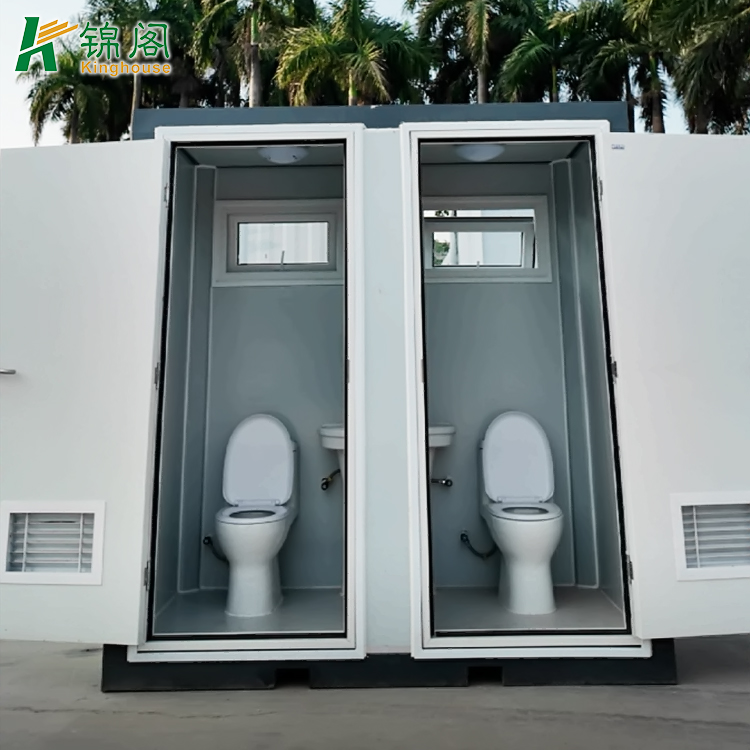
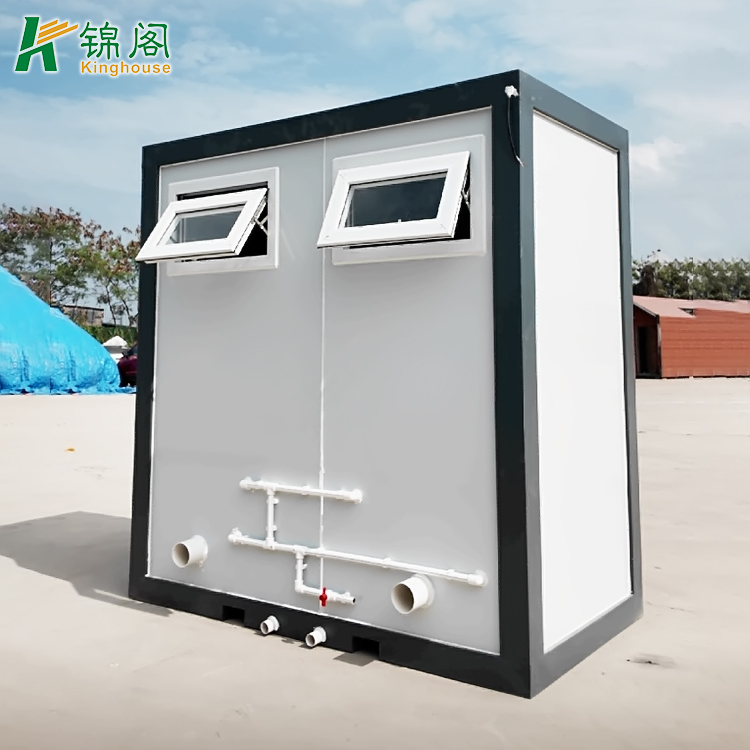
The product described here is a box-shaped, prefabricated sanitation cabin with two front entry doors, two separate toilet compartments, and visible plumbing/service points. In practical terms, it is meant to provide fast-deploy restroom capacity without building a permanent block. The visible structure suggests a modular enclosure assembled from factory-made panels, with a raised base or skid support underneath and external plumbing runs along the lower edge.
That matters because the buying decision is often driven by deployment speed. A temporary toilet that arrives preassembled, with fixtures already installed, shortens the gap between delivery and use. It also reduces the amount of site work needed before commissioning, although the exact connection method still depends on the model and site utilities. Since the build method is not fully confirmed, buyers should treat this as a modular prefab sanitation unit category rather than assume a specific transport system or tank arrangement.
Visible features that matter on site
The key visual selling points are straightforward: two usable stalls, individual front doors, small windows or vents for light and airflow, and an enclosed weather-resistant cabin shape. Inside, the fixtures appear to be white ceramic or ceramic-look toilets with smooth washable wall and floor surfaces. Those details are worth noticing because sanitation units live or die on cleanability. Rough surfaces and awkward corners make maintenance slower; smooth panels and accessible fixtures usually make daily cleaning easier.
The unit also shows side vents or grilles and overhead light or vent openings in each stall. That is not a luxury feature. Ventilation is one of the first things users notice in any portable restroom. If airflow is poor, odor lingers, heat builds up, and the unit becomes harder to keep in service. Buyers sometimes focus too much on the exterior finish and not enough on the hidden basics: airflow, drain routing, door hardware, and how easy it is for a cleaning crew to access the interior.
When a dual-stall portable restroom makes more sense than a single unit
On smaller jobs, a single mobile toilet may be enough. But once foot traffic rises, a two-stall format starts to make more operational sense. The advantage is not only extra capacity. It is also distribution. Two doors, two compartments, and two fixtures in one footprint can help reduce crowding where space is limited.
That makes this kind of portable restroom attractive for:
construction sites with rotating crews
outdoor events with concentrated peak usage
industrial yards and temporary work compounds
farm facilities or remote operations needing basic sanitation
emergency or interim facilities where permanent construction is not yet in place
There is a practical caution here, though. Buyers should not assume that two stalls automatically solve congestion. If the unit is underspecified on ventilation, plumbing access, or service frequency, the second stall simply doubles the chance of a maintenance problem. Capacity is only useful if the unit can be cleaned, supplied, and drained according to the site plan.
Construction details buyers should inspect before ordering
A portable toilet is a product of details, not slogans. The exterior appears to use painted metal or coated composite panels in white, with light-colored metal or aluminum door frames and a darker outer structure. That combination suggests a prefabricated shell designed for repeated handling and outdoor exposure. Buyers in the market for a temporary toilet should ask how the panel system handles corrosion, impact, and cleaning chemicals, especially if the unit will be moved from project to project.
The plumbing is another area that deserves attention. The visible PVC outlets and service lines suggest integrated water or drainage connections, but the exact arrangement is not confirmed. That is important. Some buyers want a self-contained setup; others need a permanently plumbed unit. Those are not interchangeable choices, and mixing them up can create expensive rework after delivery.
A second detail is interior finish. Smooth gray panels are a good sign for washdown cleaning, but buyers should still ask how seams are sealed, whether the floor is slip-resistant, and what maintenance access exists behind the wall panels. In modular sanitation equipment, the hidden serviceability often decides the real life-cycle cost.
Questions a sourcing manager should ask early
What type of water supply and drainage connection does this unit require?
Is it intended for fixed installation, forklift handling, crane lift, or another mobility method?
How are the toilets, basins, and vent openings arranged for maintenance access?
What is included as standard and what is custom-built?
Can the cabin be adapted for different site rules or local utility requirements?
These are not decorative questions. They prevent the common mistake of buying a model that looks suitable in a brochure but arrives awkward to install.
How buyers should compare portable restroom options
When comparing portable toilet products, it helps to look at three layers: user experience, serviceability, and site fit.
User experience covers odor control, privacy, airflow, lighting, and how cramped the stall feels. Even a compact cabin can work well if it is laid out sensibly. Serviceability covers cleaning, parts replacement, access to plumbing, and resistance to wear. Site fit covers footprint, entry direction, utility connection points, and whether the unit fits a work zone, a parking area, or a remote base camp.
A portable restroom that is easy to clean but hard to place can still be the wrong buy. Likewise, a unit that looks compact but creates maintenance headaches will cost more over time than the initial quote suggests. That is a buyer-facing warning worth repeating: utility layout can matter more than exterior appearance.
Where prefabricated cabin-style sanitation units fit in modern projects
Companies like Guangzhou Kinghouse Modular House Technology Co., Ltd., which has long experience in prefabricated buildings and modular construction, sit in a market that values quick deployment and customization. That broader background matters because sanitation cabins are often purchased alongside other modular facilities: site offices, dormitories, steel structures, or support rooms. Buyers do not always need a standalone toilet; sometimes they need a coordinated temporary facility package that can be designed, delivered, and serviced as one system.
Kinghouse’s stated strengths include design support, installation support, and after-sales service, along with logistics experience for domestic and international delivery. For buyers, that can be relevant when a sanitation unit is only one part of a larger temporary site plan. A portable toilet is easier to deploy when the supplier understands modular integration, not just fixture supply.
Common mistakes to avoid
The first mistake is buying on footprint alone. Compact is useful, but only if users can move through the unit comfortably and service crews can maintain it without disassembly.
The second mistake is ignoring ventilation. A mobile toilet can be fully enclosed and still perform poorly if airflow is weak. Small vents and windows are not decorative elements; they are part of the sanitation system.
The third mistake is failing to define the plumbing concept before purchase. Self-contained and fixed-plumbed solutions solve different problems. Buyers should never assume the vendor and the site team mean the same thing when they say “ready to use.”
The fourth mistake is overlooking after-sales support. Temporary toilet units take abuse. Hinges loosen, fittings age, seals need replacement, and cleaning crews need clear guidance. A supplier with a practical support channel is worth more than one with a glossy catalog.
FAQ
Is a dual-stall portable toilet suitable for events?
Yes, especially where user flow is concentrated and space is limited. It can reduce queue pressure better than a single unit, but only if servicing is planned properly.
Can this type of unit be used on construction sites?
Yes. Construction is one of the most common use cases for prefab sanitation cabins and portable restroom units, particularly where fast deployment matters.
Is it self-contained?
That is not confirmed here. Buyers should verify whether the specific model is self-contained or requires utility connections.
What should I check before placing an order?
Confirm the plumbing method, site access, utility requirements, cleaning access, and whether the cabin is designed for fixed installation or easier relocation.
What to do next
If your site needs temporary sanitation, start with usage patterns rather than product photos. Count people, check peak-hour flow, map the utility connection points, and decide whether a single mobile toilet or a dual-stall portable restroom is the better fit. Then ask the supplier for the missing technical details before you commit.
For teams evaluating modular sanitation equipment alongside broader prefabricated building needs, a supplier with factory experience, design support, and international logistics capability can simplify the process. That is especially useful when the portable toilet is part of a larger temporary site buildout and not just an isolated purchase.
Leave a Reply